
How Your Septic System Works
A septic system looks like a mystery from the surface — a green patch of lawn and a couple of lids — but it's one of the simplest machines in your house. No electricity, no moving parts, no computer. Just a buried tank, some pipe, and several feet of soil doing quiet chemistry. Understanding the handful of parts is what turns every future septic conversation from a bewildering quote into something you can reason about.
The whole system has three stages: the septic tank separates solids from liquids, the drainfield disperses the liquid underground, and the soil finishes treating it. Everything else on this site — pumping schedules, failure signs, what not to flush — is just details about keeping those three stages working.
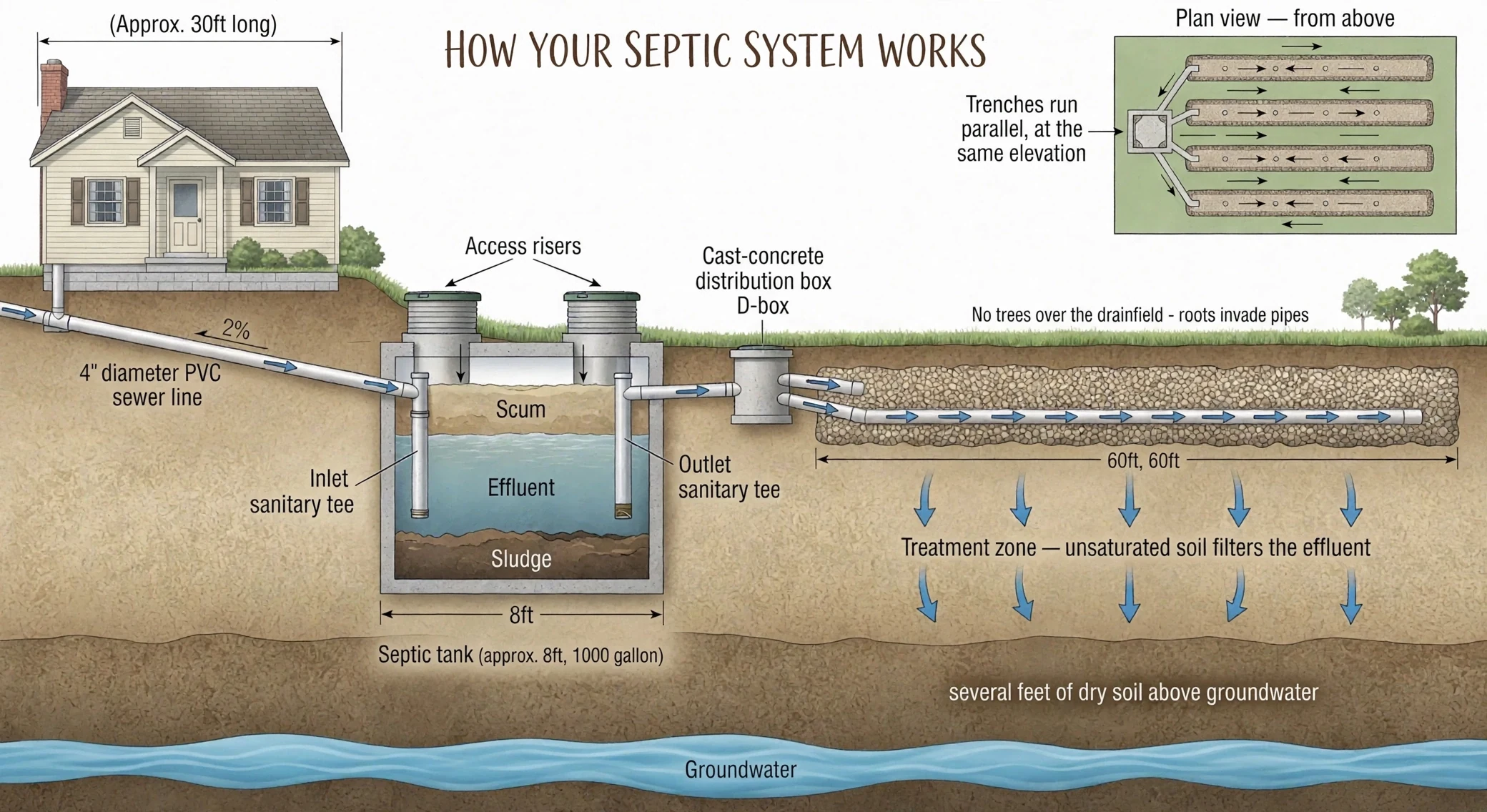
The septic tank: settle and separate
Everything from your house — toilets, showers, sinks, laundry — flows through one sewer pipe into the septic tank: a buried, watertight container, typically around 1,000 gallons for a standard home. Its job isn't to treat the wastewater. Its job is to separate it, and it does that with nothing but gravity and time.
Inside the tank, the wastewater divides into three layers:
- Scum floats on top — grease, oils, and anything lighter than water.
- Sludge sinks to the bottom — the heavier solids.
- Effluent sits in the middle — the clearer liquid, and the only thing that's supposed to leave the tank.
Two fittings make this separation actually work. The inlet sanitary tee directs incoming wastewater downward so it doesn't stir up what's already settled, and the outlet sanitary tee (or baffle) draws effluent from the middle of the tank — below the scum, above the sludge. Without those tees, solids would wash straight through to the drainfield, which is one of the fastest ways to destroy a system.
Meanwhile, anaerobic bacteria — bacteria that live without oxygen — are breaking down organic matter in the sludge and scum. They're slow and they don't finish the job; they reduce the volume of solids but never eliminate them. That's why the tank needs pumping every few years: the EPA's homeowner guidance says inspect every three years and pump every three to five, depending on tank size and household habits. (The full version of that math is in how often to pump your septic tank.)
The tank usually has access risers — extensions that bring the lids up to (or near) the surface. If your tank was installed before risers were standard, the lids are buried and someone has to dig to find them. Risers are one of the highest-value upgrades in septic ownership: they turn every future pumping and inspection from an excavation project into a ten-minute job.
The drainfield: distribute and disperse
The effluent leaving the tank flows to the distribution box (D-box), a small concrete box whose only job is fairness: it splits the flow evenly among the drainfield's laterals — parallel perforated pipes running at the same elevation through gravel-filled trenches. Even distribution matters because the soil can only absorb so much water in one spot; a D-box that's settled or clogged sends everything down one trench and overloads it.
Each lateral is a long, level trench lined with gravel, with perforated pipe running through it. Effluent trickles out along the pipe's length and percolates down through the gravel into the soil below. The trenches in the diagram run about 60 feet each — the actual length of your field was sized to your soil's absorption rate and your household's wastewater flow when the system was permitted.
Two things about the drainfield that surprise people:
- It's shallow. The trenches sit just a couple of feet below the surface. The treatment doesn't happen in the trenches — it happens in the soil below them.
- Nothing should grow on it but grass. No trees, no shrubs, no gardens, no driveways, no sheds. Tree roots seek out the water and invade the pipes; anything heavy compacts the soil and crushes the trenches. The diagram shows trees kept well away from the field for exactly this reason.
The soil: the real treatment plant
Here's the part most homeowners never hear, and it's the most important paragraph on this page: the tank doesn't treat your wastewater. The soil does.
Below each trench there should be several feet of dry, unsaturated soil before you hit groundwater. As effluent percolates down through that zone, a whole sequence of natural processes goes to work — physical filtration strains out particles, soil microbes consume pathogens and organic matter, and chemical reactions in the soil bind up nutrients like phosphorus. By the time the water reaches the groundwater table, it's been substantially cleaned. That unsaturated zone is doing more treatment than every other part of the system combined.
This is why a septic system lives or dies on its soil. A site with deep, well-draining soil gets a conventional gravity system and decades of quiet service. A site with shallow soil, high groundwater, or heavy clay gets an engineered or aerobic system instead — more treatment up front, because the soil can't be trusted to finish the job. It's also why the original perc test mattered so much, and why driving heavy equipment over your drainfield or paving over it is effectively dismantling your treatment plant.
What's normal — and what's a warning sign
A healthy septic system is aggressively boring. No odors, no wet spots, no gurgling drains, no drama. The grass over the drainfield looks like the rest of the lawn — maybe slightly greener in dry spells, which is fine. Here's the boring-versus-worried breakdown:
- Normal: Everything drains, nothing smells, the ground over the field is firm and dry. You pump the tank every few years and otherwise forget the system exists. That is the goal. That is the system working.
- Sewage odors — inside the house or over the yard. Occasional faint odor near the tank lids after pumping is one thing; persistent odor is the system telling you something's wrong.
- Soggy ground or standing water over the drainfield, especially in dry weather. Effluent is surfacing because the soil below can't take any more — the classic sign of a field in trouble.
- Slow drains or backups, especially on the lowest fixtures in the house. Can be a tank that needs pumping, or a field that isn't accepting water.
- Suspiciously lush, fast-growing stripes of grass over the trenches. The field is fertilizing the lawn with effluent it should be absorbing deeper. It looks healthy; it's a symptom.
If you see the warning signs, cut water use immediately and call a septic professional — and read signs your drainfield is failing for the full diagnosis-first walkthrough before anyone tries to sell you anything.
What the system needs from you
The maintenance list is short, which is exactly why people neglect it:
- Pump the tank on schedule — every 3–5 years per the EPA, adjusted for your household. This is the single highest-leverage thing you own. (Pumping guide)
- Watch what goes down the drains. The tank can handle human waste, toilet paper, and normal household wastewater. It cannot handle grease, "flushable" wipes (not flushable), feminine products, paint, or harsh chemicals in quantity. (What not to put in)
- Spread out water use. A system designed for your household can still be overwhelmed by five loads of laundry in one day. The soil needs time to absorb between doses.
- Keep the field clear. Grass only. No trees, no parking, no structures, no deep-rooted landscaping.
- Keep records. Pump dates, inspections, the original permit. The next owner — or the next contractor — will thank you.
None of this is complicated. It's just consistent. Systems that get these five things last decades; systems that don't become cautionary tales. (Full maintenance checklist)
Frequently asked questions
How long does a septic system last?
A well-maintained conventional system commonly lasts 20 to 30 years or more — and the concrete tank itself can outlast the drainfield by decades. What usually ends a system's life is the drainfield: the soil's ability to absorb effluent gradually declines as a biological mat (biomat) builds up along the trench bottoms. Good maintenance — regular pumping, sane water use, nothing abusive down the drains — is what gets you to the far end of that range.
Where does the waste actually go?
It doesn't go anywhere — it gets broken down. Bacteria in the tank digest a portion of the solids; the rest accumulates as sludge and scum until it's pumped out and hauled away. The liquid effluent disperses into the soil, where microbes and filtration remove pathogens and nutrients as it percolates toward groundwater. Nothing vanishes; it's all processed, just slowly and underground.
Do I need to add bacteria or additives to my tank?
No. Your wastewater arrives with all the bacteria the system needs — that's rather the point. The EPA doesn't recommend additives, and independent testing has consistently failed to show that they help. Some can actually harm the system by breaking up solids that then clog the drainfield. Save the money for your next pumping. (The longer version: septic tank treatments reviewed.)
Can I plant a garden or build over my drainfield?
Garden, no — deep roots and digging damage the trenches, and you don't want food growing in effluent-irrigated soil. Build, no — structures compact the soil and make the field unserviceable. Park cars, no — same compaction problem. Grass is the answer. Shallow-rooted grass is the only landscaping a drainfield wants.
What's the difference between septic and sewer?
Ownership. On sewer, you pay a monthly bill and the municipality handles everything downstream of your property line. On septic, there's no bill — but you own the entire treatment plant, the maintenance schedule, and the replacement cost. A septic system is cheaper month-to-month and more expensive in the years something needs doing. Most rural homeowners come out ahead financially as long as they maintain the system instead of ignoring it.
Does a septic system use electricity?
A conventional gravity system: no. That's one of its genuine virtues — it works through power outages without noticing. Aerobic systems, systems with effluent pumps (for uphill drainfields), and anything with alarms or controls do use power. If your system has an alarm panel, find out what it's wired to before you need to know. (Aerobic vs. conventional)