
Aerobic vs Conventional Septic Systems: What's the Difference?
If you're building, buying, or replacing a system, this is the first fork in the road: a conventional (anaerobic) septic system or an aerobic treatment unit (ATU). They both do the same job — treat your household wastewater — but they do it very differently, cost very differently, and ask very different things of you afterward.
Here's the short version: a conventional system is simpler, cheaper, and needs less attention. An aerobic system treats wastewater to a higher standard, which makes it the right call (sometimes the only legal call) on difficult sites — small lots, poor soil, high water tables. It costs more up front and needs ongoing maintenance.
The rest of this article is the detail behind that summary, so you can make the call with confidence.
How a conventional septic system works
A conventional system has two main parts: the septic tank and the drainfield (also called a leach field or soil absorption field).
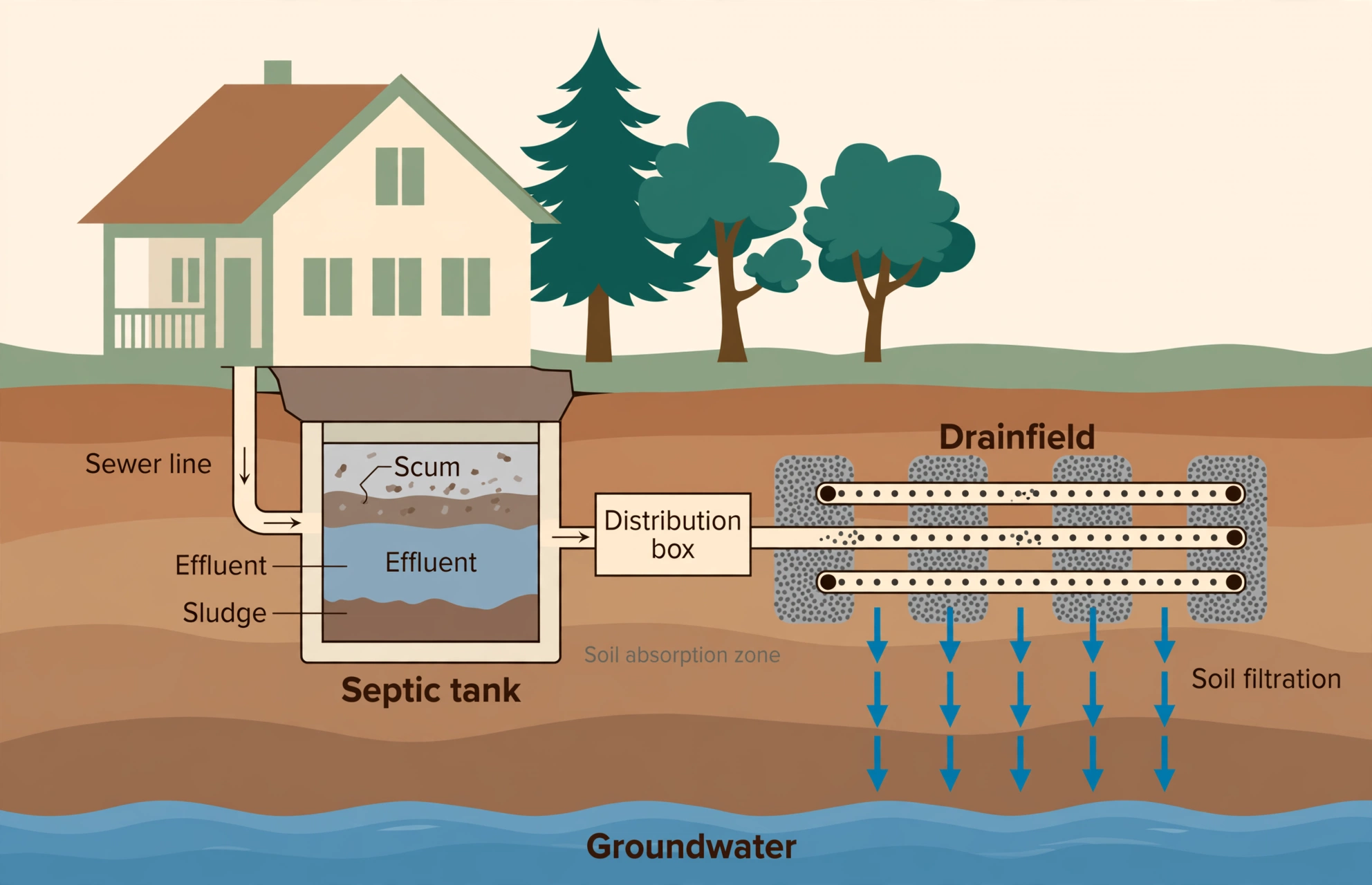
Wastewater flows from your house into the septic tank, a buried watertight container. Inside, solids settle to the bottom as sludge and lighter materials (grease, oils) float to the top as scum. Anaerobic bacteria — bacteria that live without oxygen — break down the organic matter in between. This is passive. Nothing is powered, nothing moves, nothing beeps.
The partially treated liquid in the middle layer (the effluent) flows out to the drainfield: a network of perforated pipes buried in gravel-filled trenches. The effluent trickles out, filters down through the soil, and the soil finishes the treatment job — removing pathogens and nutrients before the water rejoins the groundwater.
The soil is doing heavy lifting in a conventional system, which is why soil quality matters so much. Good, deep, well-draining soil is the whole ballgame.
How an aerobic septic system works
An aerobic treatment unit adds a step the conventional system doesn't have: it forces oxygen into the wastewater so that aerobic bacteria — which are far more aggressive decomposers than anaerobic bacteria — can break down waste much more thoroughly.
A typical ATU has several chambers:
- Pretreatment/trash tank — works like a conventional septic tank, settling out solids.
- Aeration chamber — an air pump (compressor) pushes air through diffusers, churning the wastewater with oxygen. Aerobic bacteria digest the organic matter here.
- Clarifier/settling chamber — the flow quiets down so remaining solids settle out.
- Disinfection — many systems add a chlorinator or UV light to kill pathogens.
- Pump tank and dispersal — the highly treated effluent is pumped to a drainfield, drip irrigation lines, or in some jurisdictions sprayed on the surface.
The result is effluent that's dramatically cleaner than what leaves a conventional tank — which is exactly why regulators allow aerobic systems on sites where conventional systems would contaminate groundwater.
The tradeoff: the system needs electricity 24/7, has moving parts (air pump, floats, alarms), and in many states requires a professional maintenance contract with scheduled inspections.
Side-by-side comparison
| Conventional (anaerobic) | Aerobic (ATU) | |
|---|---|---|
| Treatment method | Anaerobic bacteria in tank + soil filtration | Oxygen-fed aerobic bacteria + clarification + disinfection |
| Effluent quality | Partially treated; soil finishes the job | Highly treated before it ever reaches soil |
| Soil requirements | Demanding — needs deep, permeable soil | More forgiving — works on poor soils, high water tables, small lots |
| Drainfield size | Larger | Can be smaller |
| Electricity | None | Required continuously (air pump, controls, alarms) |
| Moving parts | Essentially none | Air pump, diffusers, floats, pumps, alarms |
| Maintenance | Pump tank every 3–5 years; inspect drainfield | Pump as needed + service contract, typically 2–4 professional visits per year (quarterly is common — e.g., Texas requires inspections every 4 months; Florida requires twice yearly) |
| Upfront cost | Lower | Higher — often substantially |
| Ongoing cost | Minimal | Electricity + service contract + replacement parts (air pumps wear out) |
| Lifespan | Tank 25–40 years; drainfield 20–30 years with care | Similar tank life; mechanical components need replacement on a shorter cycle |
| Noise | Silent | Faint hum from the air pump |
Cost differences, honestly
A conventional system is almost always cheaper to install — fewer components, no electrical work, no control panels. An aerobic system adds the treatment unit itself, electrical hookup, and often a more engineered dispersal setup.
The gap that surprises people is the ongoing cost. A conventional system costs you a pump-out every few years and not much else. An aerobic system has an electric bill (modest but real), a maintenance contract that many jurisdictions legally require, and parts that wear out — air pump diaphragms and diffusers are consumables, not lifetime components.
In 2026 terms, a conventional installation typically runs $3,000–$8,000 (the national average sits around $8,000, per a March 2026 survey of 85+ installers; Texas conventional installs run $6,300–$10,000). Aerobic systems typically run $10,000–$20,000 installed, with some sources citing up to $25,000+. On difficult sites — poor soils, high water tables, engineered designs — aerobic or alternative systems can exceed $25,000–$30,000+. These are planning ranges, not quotes: soil, access, permits, and local labor move real bids well outside them, so get 2–3 local quotes as your ground truth.
Over a 20-year horizon, the total cost of ownership gap between the two is much larger than the installation quotes suggest. Get the maintenance contract price in writing before you choose.
Which one do you actually need?
This often isn't a free choice. Here's how the decision usually gets made:
- Your soil passes a perc test and you have room → conventional is the sensible default. Simpler and cheaper.
- Poor soil, high water table, small lot, or near a well/waterway → the health department may require aerobic treatment. In many counties, there's no conventional option on paper.
- You're replacing a failed system on a tight lot → aerobic is often the only way to fit a legal system on the property.
- You just prefer the best treatment available → aerobic produces cleaner effluent, full stop. Some homeowners choose it voluntarily for environmental reasons.
Check with your county health department or environmental health office early — they'll tell you what's permitted on your specific parcel before you spend a dollar on design.
Can you convert a conventional system to aerobic?
Sometimes. Retrofit aerobic units can be installed inside an existing septic tank, converting it into an aeration chamber. This can make sense when a drainfield is marginal and you need cleaner effluent to keep it alive, or when regulations change.
But it's not a magic fix: a retrofit still needs electricity, still needs maintenance, and it won't resurrect a drainfield that's physically failed (compacted, clogged beyond recovery, or built in unsuitable soil). Get a professional assessment of the drainfield first — if the soil absorption is gone, you're looking at replacement, not conversion.
Questions to ask before you choose
Whether you're deciding voluntarily or the health department is deciding for you, these questions will save you money and regret:
For the county health department / permitting office:
- What system types are permitted on my parcel?
- Is a maintenance contract required for aerobic systems here, and what must it cover?
- What's the permit timeline? (It affects your build schedule.)
For installers (get at least three quotes):
- What exact system are you proposing, and why this one for my soil?
- What's included in the quote — design, permits, electrical, abandonment of the old system, final grading?
- For aerobic: what's the annual service contract cost, and who provides it? Get it in writing.
- What mechanical components will need replacement, on what schedule, and at what cost?
- What warranty do you offer, and what voids it?
For yourself:
- Am I comfortable with a system that needs electricity and professional service forever, or do I want the simplest thing that meets code?
- If I'm selling within 10 years, which choice makes the property more attractive to buyers? (A newer aerobic system with a transferable service contract is a selling point; an aging conventional system with no records is a negotiation weapon — for the buyer.)
Frequently asked questions
Do aerobic septic systems smell?
They shouldn't. A properly functioning ATU is typically odor-free — the aerobic process doesn't produce the sulfur compounds that make anaerobic systems smell. If you smell sewage, something's wrong: check the air pump first.
What happens to an aerobic system in a power outage?
The bacteria start dying back without oxygen. Short outages (hours) are usually fine. Extended outages can disrupt treatment for days afterward. Some owners add a backup power source for the air pump — worth discussing with your installer if outages are common in your area.
Are aerobic systems required to have a maintenance contract?
In many states and counties, yes — it's a permit condition, not a suggestion. Even where it's not legally required, skipping professional service on a system with mechanical parts is asking for an expensive failure.
How long do aerobic systems last?
The tanks last as long as conventional tanks (decades). The mechanical components — air pumps, diffusers, floats — have much shorter lives and should be budgeted as recurring replacements. Air pumps typically last 5–10 years; the diaphragms inside them are consumables that usually need replacement every 4–6 years (rebuild kits run roughly $100–$150; a new pump roughly $300–$600+).
Can I install either system myself?
In most jurisdictions, no — septic installation requires permits, licensed installers, and inspections. DIY septic is a fast track to a failed inspection and contaminated groundwater. This is one job to hire out.